

R&D2019–2022EDF · Paris
Steam Generator Clogging Assessment from Eddy-Current Signals
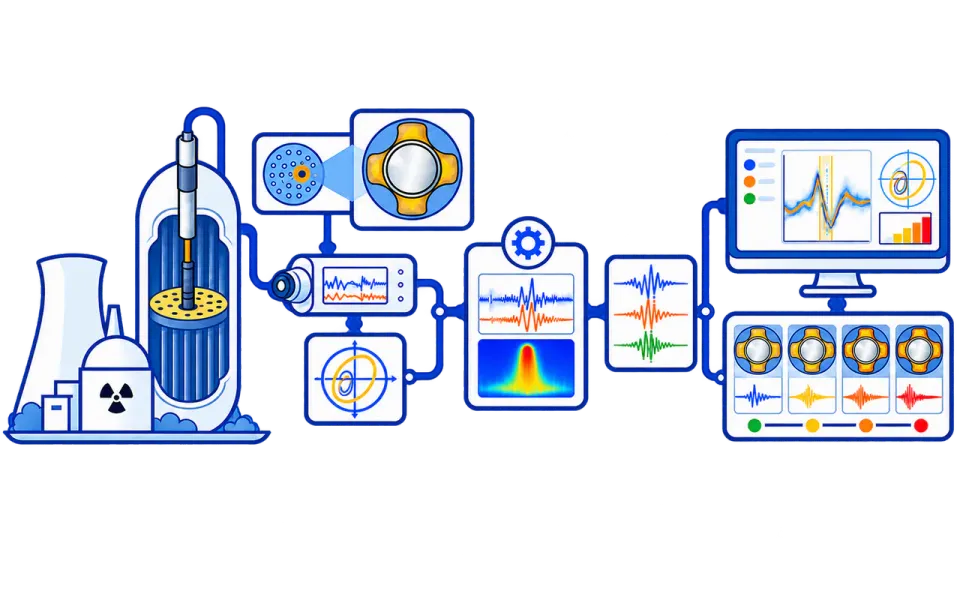
Processing and deconvolution of SAX eddy-current signals to help engineers assess steam-generator support-plate clogging during periodic inspections.
R&D
Development and industrialization of engineer-facing software combining signal alignment, DTW, and statistical anomaly detection to prioritize atypical steam-generator inspection signals for expert review.

Processed multidimensional signals acquired during periodic eddy-current inspections of steam-generator tubes.
Variations in probe velocity can shift otherwise comparable signal patterns. The processing pipeline therefore realigns inspection signals before they are compared.
Probe displacement is reconstructed from the acquisition sequence and inspection speed. Known geometric landmarks, including tube-support-plate locations, are then used to refine the alignment between the signal and its physical position along the tube.
This provides a consistent basis for comparing signals acquired from geometrically similar tubes.
Dynamic Time Warping (DTW) is used to synchronize comparable inspection signals against a common reference while accounting for local differences in acquisition speed.
This makes local signal deviations easier to distinguish from simple positional misalignment.
After synchronization, Local Outlier Factor (LOF) is applied to identify signals that differ locally from the behavior observed across comparable tubes.
Rather than replacing expert diagnosis, the method highlights potentially anomalous sections and prioritizes them for targeted review by inspection specialists.
Signals are compared within groups of tubes with similar geometry so that expected structural effects are separated as far as possible from atypical responses.
The algorithms were integrated into an application designed for inspection engineers.
Users could navigate inspection campaigns and individual tubes, visualize raw and processed signals, inspect automatically highlighted sections, and review results in their physical context.
The objective was not to replace NDT expertise with an automatic classification system.
Instead, automated screening was used to focus expert attention on the signals most likely to contain unusual behavior, allowing large inspection datasets to be reviewed more efficiently.
The application supported interactive signal analysis, validation of detected anomalies, comparison of inspection results, and generation of outputs for the wider inspection workflow.
Owned the software architecture and implemented most of the research application, including module and interface design, code review, release preparation and integration of the signal-processing algorithms.
Development was carried out in close interaction with EDF R&D engineers and inspection specialists so that the analysis workflow remained compatible with operational NDT practices.
The research implementation was validated with domain experts and progressed from prototype development to use within inspection activities.
Technical oversight was also provided during the industrialization of MATLAB-based processing components by an external development team, including review of the resulting production implementation and interfaces.
Processing and deconvolution of SAX eddy-current signals to help engineers assess steam-generator support-plate clogging during periodic inspections.