Energy Data Solutions
Menu
Other

PyTorch

PyTorch provides tensor computation and automatic differentiation for developing deep-learning models on CPUs and GPUs. Its flexible programming model is well suited to custom neural architectures, experimental training pipelines and the evaluation of models combining images, sequences or time-series data.

PyTorch

Related skills

  • Forecasting

    Forecasting

    Predicting future values using historical data patterns, statistical models, and machine learning algorithms

  • Data Science

    Data Science

    Extracting insights and building predictive models from data using statistics, machine learning, and programming

  • Data Visualization & Reporting

    Data Visualization & Reporting

    Creating visual representations of data to communicate insights, patterns, and trends effectively

  • Research

    Research

    Applies rigorous scientific methods to explore, test, and validate data-driven ideas.

Project steps

  1. Regional Solar Power Forecasting with Deep Learning

    Spatiotemporal Modeling

    ConvLSTM Model

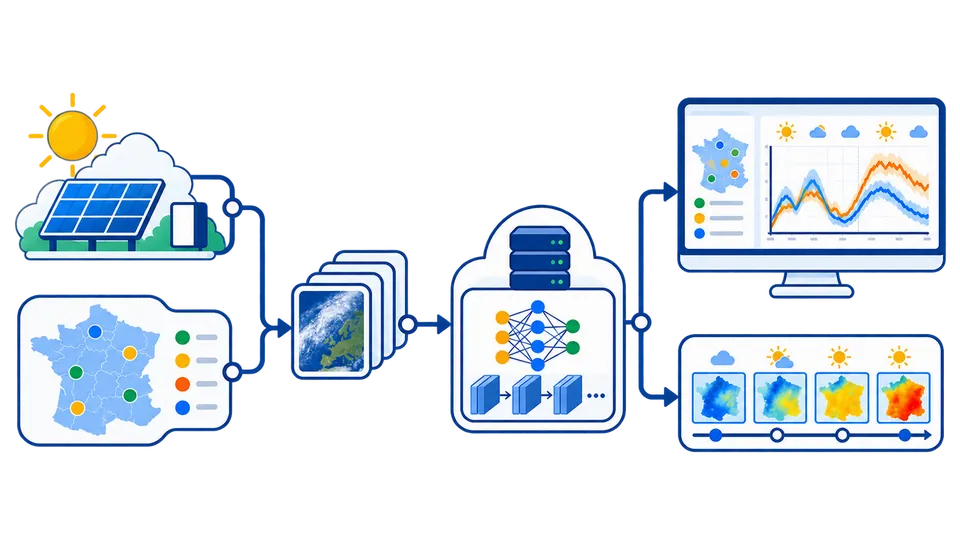
    Developed a ConvLSTM-based model to learn spatiotemporal relationships between successive satellite images and regional photovoltaic production.

    Satellite image sequences were combined with solar-position information to estimate clear-sky-normalized PV production.

    Training Pipeline

    Implemented the PyTorch training and validation pipeline for large image and time-series datasets, covering data preparation, model training, checkpointing, and application to unseen periods.

    Evaluation

    Model outputs were converted back to the PV production scale and compared with measured production and a persistence baseline using standard forecasting metrics.


  2. Regional Solar Power Forecasting with Deep Learning

    Forecasting Experiments

    Nowcasting and Short-Term Forecasting

    Evaluated the same modeling pipeline for current-state estimation and short-term forecasting from sequences of satellite images.

    Experiments were carried out across multiple geographic areas and time periods to assess the consistency of the approach.

    Persistence Baseline

    Persistence was used as the reference forecast, providing a simple and interpretable benchmark for evaluating the deep-learning model.

    Application to Unseen Data

    Trained models were applied to held-out periods, with predicted and measured regional PV production compared through time-series analysis and summary metrics.

Related projects

Regional Solar Power Forecasting with Deep Learning
R&DEDF · Paris

Regional Solar Power Forecasting with Deep Learning

Spatiotemporal forecasting of regional photovoltaic production from Meteosat image sequences using a ConvLSTM model trained and evaluated against measured production and a persistence baseline.

View Project