Forecast Evaluation Metrics - Scientific Paper
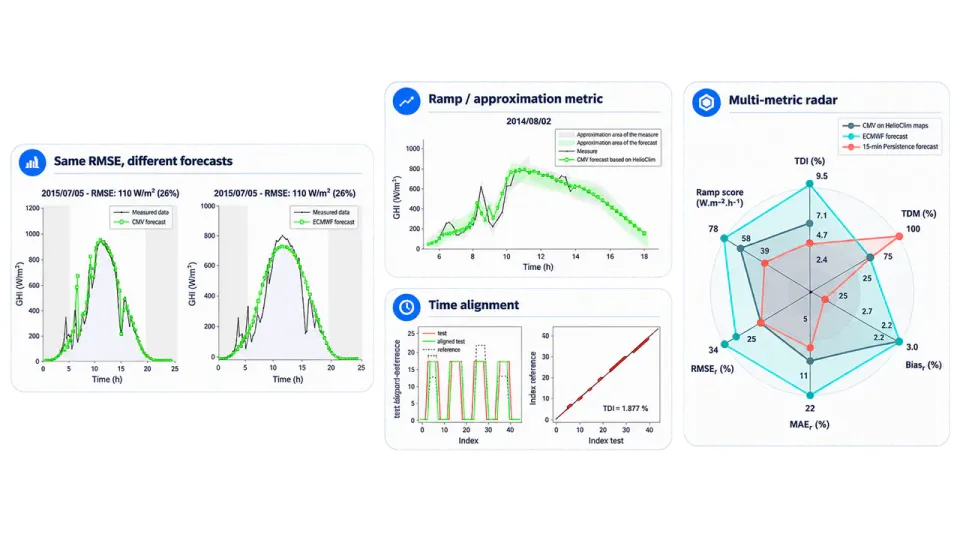
Scientific framework for evaluating solar forecasts beyond average error metrics, using Temporal Distortion Mix and a ramp metric to assess timing errors and rapid irradiance variations.
R&D
Spatiotemporal forecasting of regional photovoltaic production from Meteosat image sequences using a ConvLSTM model trained and evaluated against measured production and a persistence baseline.

Prepared aggregated photovoltaic production time series for multiple French departments, together with solar-position features and clear-sky normalization used by the forecasting pipeline.
Processed Meteosat Second Generation image sequences, extracted the geographic areas associated with each forecast region, and aligned them in time with the corresponding PV production series.
Developed a ConvLSTM-based model to learn spatiotemporal relationships between successive satellite images and regional photovoltaic production.
Satellite image sequences were combined with solar-position information to estimate clear-sky-normalized PV production.
Implemented the PyTorch training and validation pipeline for large image and time-series datasets, covering data preparation, model training, checkpointing, and application to unseen periods.
Model outputs were converted back to the PV production scale and compared with measured production and a persistence baseline using standard forecasting metrics.

Evaluated the same modeling pipeline for current-state estimation and short-term forecasting from sequences of satellite images.
Experiments were carried out across multiple geographic areas and time periods to assess the consistency of the approach.
Persistence was used as the reference forecast, providing a simple and interpretable benchmark for evaluating the deep-learning model.
Trained models were applied to held-out periods, with predicted and measured regional PV production compared through time-series analysis and summary metrics.
Measured and predicted photovoltaic production were compared using time-series and scatter plots across forecast areas and evaluation periods.
Forecasts were evaluated using conventional error metrics including MAE, RMSE, and nRMSE.
Temporal-alignment and ramp-oriented diagnostics were also used to examine forecast timing and behavior during rapid changes in solar production.

Scientific framework for evaluating solar forecasts beyond average error metrics, using Temporal Distortion Mix and a ramp metric to assess timing errors and rapid irradiance variations.

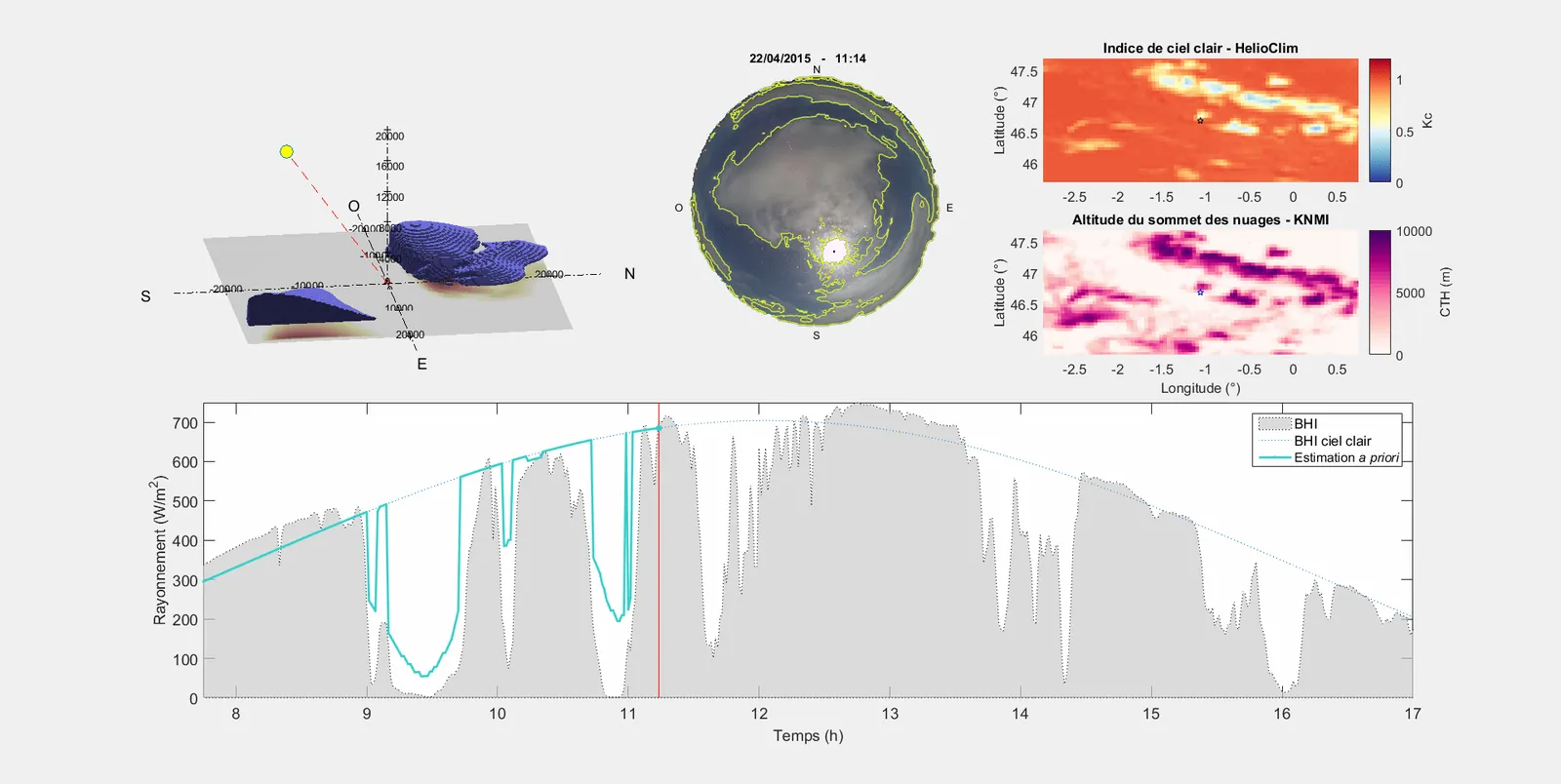
Controlled simulator of 3D cloud scenes, generating synthetic satellite and ground-camera views to validate voxel-based reconstruction, cloud localization, and shadow prediction for solar forecasting.

Fusion of ground-based sky-camera and geostationary satellite imagery to reconstruct cloud geometry and forecast solar irradiance and cloud shadows from 10 minutes to several hours ahead.