Energy Data Solutions
Menu

PhD Research

Forecast Evaluation Metrics - Scientific Paper

Scientific framework for evaluating solar forecasts beyond average error metrics, using Temporal Distortion Mix and a ramp metric to assess timing errors and rapid irradiance variations.

  • 2017
  • Mines Paris - PSL
Forecast Evaluation Metrics - Scientific Paper

Article content

The paper proposes a standardized framework to assess solar forecast accuracy. It focuses on evaluating not just the size of forecast errors, but also their timing and ability to capture rapid solar variations.

Key Idea

Traditional error measures like RMSE, MAE, or Bias overlook how forecasts align in time with real events. To address this, the authors introduce two complementary indicators:

  • Temporal Distortion Mix (TDM) - quantifies how early or late a forecast is compared to reality.
  • Ramp Metric - measures how well forecasts capture sudden changes in solar irradiance.

Our Approach

2 Project Steps

  1. Step 1 of 2

    Evaluation Method

    The framework defines a clear, repeatable process to measure forecast quality.

    Data Preparation

    • Filter and validate measured solar irradiance data.
    • Group results by weather conditions and seasons for consistent analysis.

    Metric Computation

    • Calculate traditional error metrics (RMSE, MAE, Bias) for general accuracy.
    • Compute TDM to assess time alignment between forecasts and observations.
    • Compute the Ramp Metric to evaluate how precisely short-term irradiance variations are reproduced.
    • Visualize results using radar plots for a multi-dimensional comparison.
  2. Step 2 of 2

    Results and Insights

    The combined use of standard and new metrics gives a more complete understanding of forecast performance.

    Added Value of New Metrics

    • TDM reveals if a model systematically predicts events too early or too late.
    • Ramp Metric highlights how well the forecast responds to rapid cloud or irradiance fluctuations.

    Together, they expose weaknesses that average error metrics alone cannot detect.

Regional Solar Power Forecasting with Deep Learning
R&DEDF · Paris

Regional Solar Power Forecasting with Deep Learning

Spatiotemporal forecasting of regional photovoltaic production from Meteosat image sequences using a ConvLSTM model trained and evaluated against measured production and a persistence baseline.

View Project
3D Cloud Geometry Simulator
PhD Research2017Mines Paris - PSL

3D Cloud Geometry Simulator

Controlled simulator of 3D cloud scenes, generating synthetic satellite and ground-camera views to validate voxel-based reconstruction, cloud localization, and shadow prediction for solar forecasting.

View Project
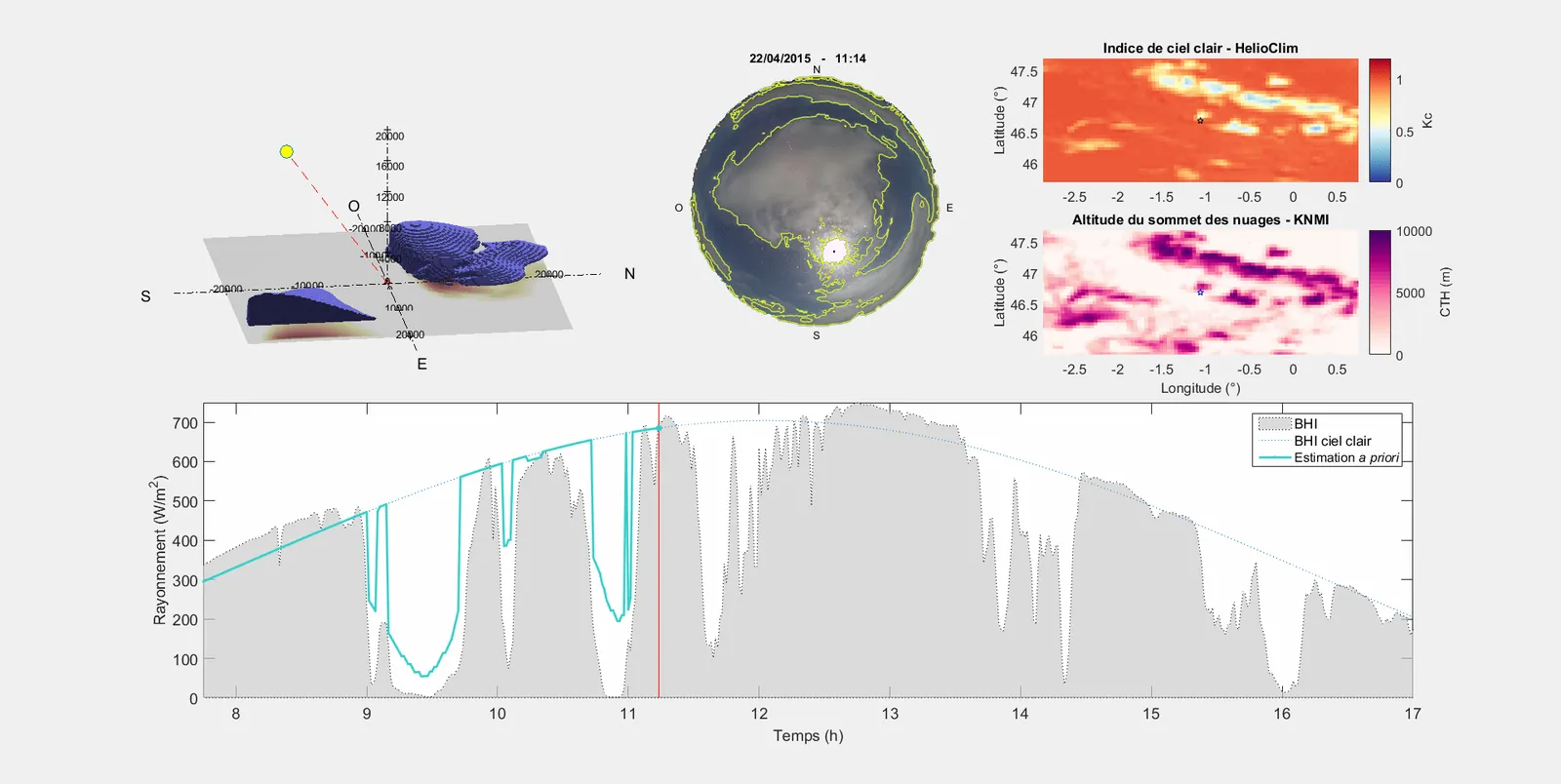
Synergy of Ground and Satellite Data for Solar Forecasting
PhD Research2018Mines Paris - PSL

Synergy of Ground and Satellite Data for Solar Forecasting

Fusion of ground-based sky-camera and geostationary satellite imagery to reconstruct cloud geometry and forecast solar irradiance and cloud shadows from 10 minutes to several hours ahead.

View Project