Data Engineering & Analytics Modernization
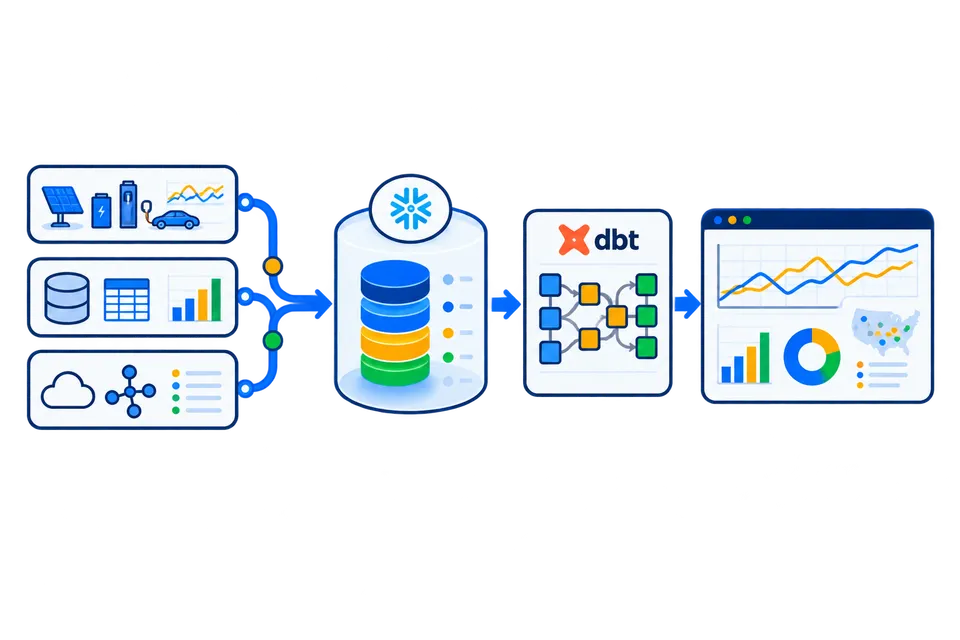
End-to-end development and modernization of a data platform spanning production ingestion, analytics engineering, quality controls, and reporting for operational, business, and customer-facing use cases.
Industry
Reliability analytics for 70,000+ managed EV chargers, reconstructing consistent per-port uptime from operational state, connectivity, asset history, and downtime exclusions for operational and customer-facing reporting.

Built a consistent reliability dataset from charger operational states and connectivity information collected across a heterogeneous EV charging network.
For each charging port, operational and online status were combined on a common time basis so that availability could be evaluated consistently across equipment and sites.
Reporting logic also accounted for changes in the charger fleet over time, including commissioning periods, decommissioned or replaced equipment, site reporting windows and asset reassignment.
This ensured that reliability calculations were based on the equipment that was actually expected to be operational during each reporting period.
Developed per-port uptime metrics based on whether charging equipment was both operational and reachable by the charging platform.
Rather than relying on a single status field, the methodology combines several operational signals to provide a more defensible representation of charger availability.
Several complementary uptime metrics were implemented to account for different operating conditions and interpretations of charger availability.
This allowed reliability to be analyzed without forcing every operational scenario into a single definition.
The model incorporates defined reporting periods and approved downtime exclusions so that reliability can be evaluated consistently for operational, customer and reporting use cases.
The methodology was developed in the context of evolving industry and California EVSE reliability requirements while supporting a much broader charging portfolio.
Designed the analytics model around individual charging ports, with derived reliability intervals that could be aggregated consistently from charger level through site and portfolio reporting.
Input data were normalized onto a consistent time basis before aggregation, simplifying the calculation of time-weighted availability across heterogeneous equipment.
Implemented automated validation around asset coverage, reporting periods, downtime exclusions and metric consistency.
The resulting transformation pipeline provided a reproducible definition of uptime rather than relying on dashboard-level calculations or manually maintained metrics.
The models were implemented as production analytics workflows and maintained through version-controlled transformations, automated testing and documented metric definitions.

Developed reporting that allows reliability to be analyzed from portfolio-level summaries down to individual sites and charging ports.
This makes it possible to move from a high-level uptime indicator to the equipment and time periods responsible for changes in the metric.
Reliability metrics were also integrated into customer-facing reporting, providing visibility into charger uptime alongside other EV charging performance information.
The same underlying data model supports operational analysis, internal reporting and customer-facing views, providing a consistent reliability definition across different levels of the organization.
Integrated the uptime framework into recurring operational and customer-facing reporting.
Reporting views supported comparison across the charging portfolio, sites and individual ports.
The same reliability definition was used across these views, keeping interpretations consistent.

End-to-end development and modernization of a data platform spanning production ingestion, analytics engineering, quality controls, and reporting for operational, business, and customer-facing use cases.